

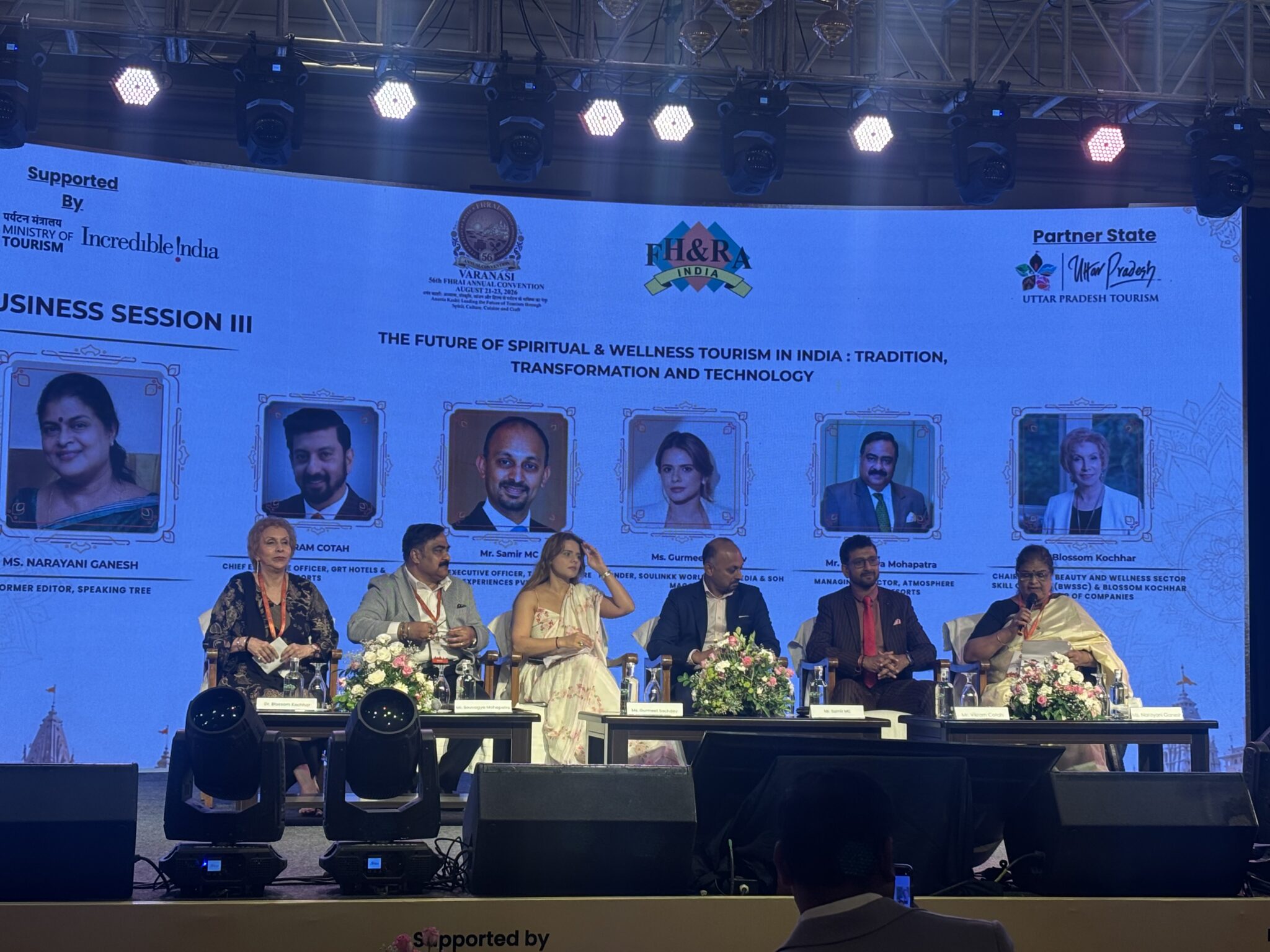
India’s spiritual and wellness tourism market presents a significant opportunity for the hospitality sector, with industry leaders calling for destination-specific hotels, stronger storytelling, local cuisine, technology-enabled crowd management and immersive experiences to encourage longer stays.
Industry leaders shared their views at the FHRAI 56th Annual Convention, held at Taj Ganges, Varanasi, on August 22. The session, titled The Future of Spiritual & Wellness Tourism in India: Tradition, Transformation and Technology, was moderated by Narayani Ganesh, Former Editor, Speaking Tree. The panel comprised Vikram Cotah, Chief Executive Officer, GRT Hotels & Resorts; Samir MC, Chief Executive Officer, Tamara Leisure Experiences Pvt. Ltd.; Gurmeet Sachdev, Founder, Soulinkk World-Wide Media & SOH Magazine; Souvagya Mohapatra, Managing Director, Atmosphere Hotels & Resorts; and Dr Blossom Kochhar, Chairperson, Beauty and Wellness Sector Skill Council (BWSSC) and Blossom Kochhar Group of Companies.
Spiritual tourism gains hospitality focus
Vikram Cotah said GRT Hotels had identified the potential of spiritual tourism nearly two decades ago, beginning with its first hotel in Madurai.
“We laid our bets on spiritual tourism 20 years back when we opened our first hotel in Madurai,” Cotah said. He added that the group today connects several important spiritual destinations across South India.
Sustainability and well-being, he said, have been incorporated into the group’s hospitality approach. “We believe that our hotels are all sustainability-first hotels. We are 100% plastic-free. All our hotels are no smoking and all our hotels are also pet friendly.”
Cotah said India’s heritage, traditions and domestic travel base give the country a strong foundation for spiritual tourism.
“India, we have an unfair advantage. We first of all have a 5,000 year soul culture filled with tradition, storytelling, and also we have fantastic assets across,” he said.
Faith-led hospitality emerging as a new opportunity
Samir MC highlighted the opportunity across both primary and secondary wellness travel, pointing to Ayurveda and faith-based tourism as areas where specialised hospitality products can be developed.
“We are one of the few hotel companies that operate Ayurveda Hospital in Aleppey,” he said, adding that the model has received a positive response from European travellers and the company is also exploring an international expansion.
He said the growth of spiritual travel was creating demand for hotels that understand the purpose behind a guest’s journey.
“There are very few hotels that really understand the purpose of the travel or the journey,” MC said.
Tamara has responded by developing what he described as its first “faith-intelligent” hotel brand. The company recently opened its first property in Guruvayur and is planning further expansion, including a 120-room hotel in Kumbakonam and another 180-room property.
Storytelling seen as key to destination development
Souvagya Mohapatra said spiritual tourism is deeply rooted in India’s history and should be developed while retaining the character of sacred destinations.
“It is 1,000 years old tradition segment,” he said, adding that the opportunity now is to present India’s spiritual destinations to contemporary travellers through better facilities, experiences and storytelling.
The panel also discussed the transformation of destinations such as Varanasi and Ujjain and the growing role of technology in managing high visitor volumes.
The Maha Kumbh was cited as an example of how technology, including facial recognition and digital systems, can support the management of large gatherings.
“Technology cannot dilute your spiritual experience, but it can be used to reduce the conflict that we face,” the panel noted.
For the hospitality industry, the larger opportunity lies in converting short pilgrimage visits into longer destination stays. The panel highlighted destinations such as Tirupati, where travellers often visit primarily for darshan and return within a short period.
The question for hoteliers is how accommodation, food, wellness, heritage and local experiences can be brought together to encourage visitors to stay longer.
From experience to transformation
The panel also highlighted a shift in traveller expectations, particularly among younger consumers.
Cotah said the industry needs to move towards transformation-led travel rather than focusing only on conventional experiences.
“I think today it’s about transformation,” he said. He explained that a destination’s deeper meaning emerges when its stories are communicated effectively.
“You go to a mountain with a geography, and if you add a story to it, it becomes a pilgrimage. Similarly, Ganga is a river, and you add a story to it,” Cotah said.
He added that storytelling needs to reach hotel employees as well. “That story has to be told not only to our guests, it has to be told to our staff too, so that they also know what they are doing.”
Cotah also suggested that “well-being tourism” may better describe the broader opportunity than wellness tourism, as the concept extends beyond physical treatments to mental, emotional and spiritual well-being.
Hotels can shape the spiritual journey
The panel identified hotel design, sensory experiences and food as important elements in creating a meaningful stay.
Mohapatra said the guest experience should begin even before arrival at the hotel, with elements such as fragrance, design and service contributing to a sense of calm.
“Design of the hotel is in our hands,” he said, highlighting the importance of reflecting the local character and culture in hotel design.
Food was also identified as a major part of destination-led hospitality. The panel called for greater emphasis on authentic regional and temple cuisine, including sattvic meals, rather than simply adding a few local dishes to a standard hotel menu.
“Not just by adding one ingredient from the region doesn’t mean that is true,” the panel noted.
Sustainability and local communities
Sustainability was discussed as another area where hotels can make a direct contribution to destination development.
MC said waste management at resorts needs to begin with reducing waste generation, followed by recycling and responsible processing.
“At our home resort, we don’t send out any waste except for e-waste. Everything else is transformed by recycling or bio waste because it goes back to the coffee plantations,” he said.
At the company’s Coorg resort, guests are also introduced to the surrounding landscape through plantation walks and treks, while the experiences create awareness about the tribal communities living around the property.
Mid-market segment emerging as key growth area
The panel identified mid-market accommodation as an important requirement for India’s growing domestic spiritual tourism market, particularly across Tier-II and Tier-III destinations.
“Mid-market is mainly the biggest segment, and that’s what is the future of India domestic and Tier-II and Tier-III cities,” Cotah said.
The speakers noted that travellers’ willingness to spend varies by destination, availability and the quality of the experience. In several spiritual destinations, limited branded accommodation can also push travellers towards higher-priced alternatives simply because of availability.
The panel highlighted a growing interest in spiritual destinations beyond the primary religious visit. Travellers are increasingly exploring architecture, heritage, local culture, cuisine and destination stories alongside temple visits.
Spiritual tourism extends beyond religious sites
The discussion also broadened the definition of spiritual tourism beyond temples and religious destinations.
“Some of us feel that temples are spiritual, churches are spiritual. Not necessarily. The last week I trekked to Valley of Flowers, and that was a very spiritual experience,” Cotah said.
The panel concluded that India’s opportunity lies in developing multi-dimensional destination experiences that bring together spirituality, wellness, heritage, nature, cuisine and technology.