

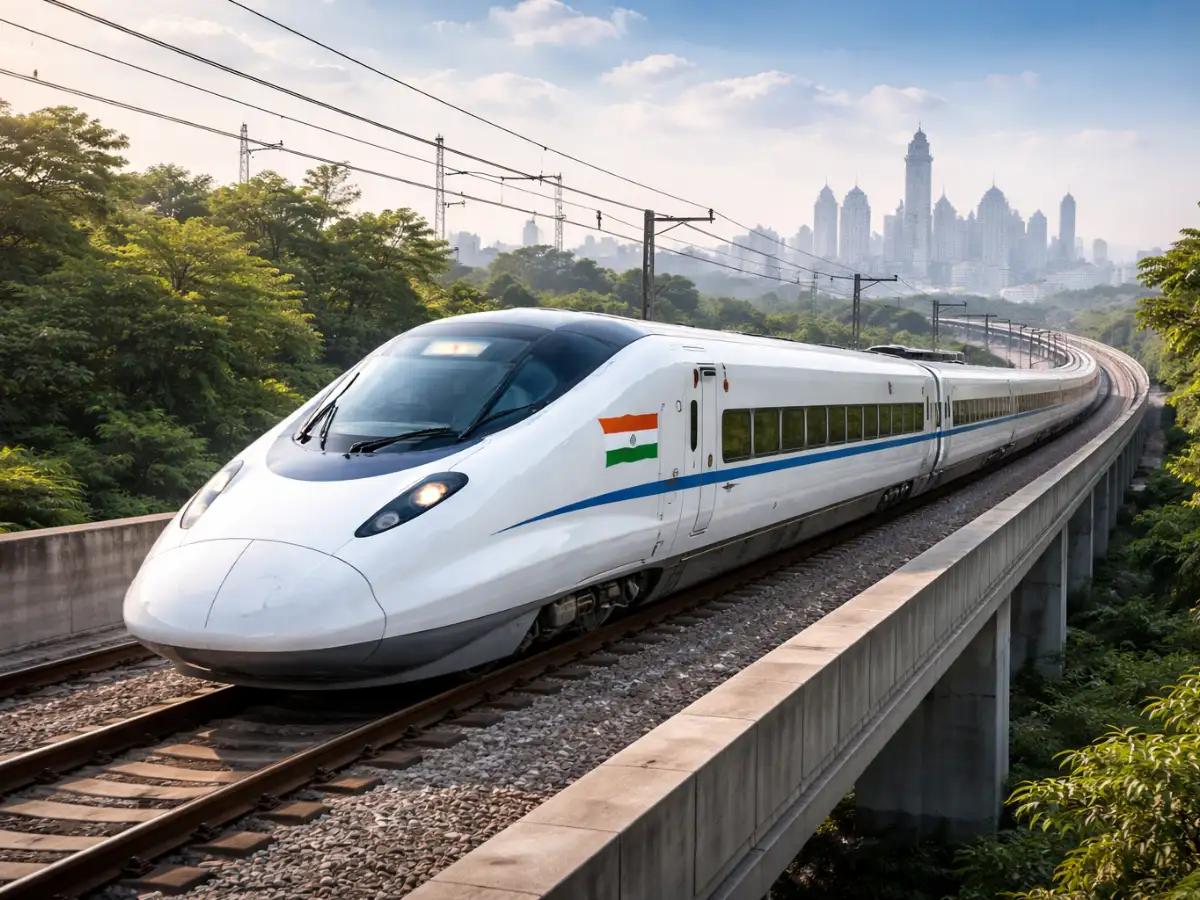
India is set to enter a new era of high-speed rail travel with the Mumbai–Ahmedabad High-Speed Rail (MAHSR) corridor scheduled to become operational on August 15, 2027.
Announced by Railway Minister Ashwini Vaishnaw, the project marks a landmark leap in the country’s transport infrastructure and showcases India’s ambition to adopt world-class mobility solutions.
The bullet train corridor will be rolled out in phases across its 508-kilometre length, significantly reducing travel time between Mumbai and Ahmedabad. The service will be based on Japanese Shinkansen technology, known globally for its speed, safety, and reliability, bringing international standards to India’s railway network for the first time.
Initial operations will begin on shorter sections before full connectivity is achieved. The Surat–Bilimora stretch will be the first to open, followed by Vapi–Surat and Vapi–Ahmedabad. Services will then extend from Thane to Ahmedabad, with the final phase completing the Mumbai–Ahmedabad link.
Once fully operational, the corridor will connect major economic and industrial hubs such as Mumbai, Thane, Vapi, Surat, Bharuch, Vadodara, and Ahmedabad. This enhanced connectivity is expected to boost business travel, tourism, and regional economic integration across western India.
Construction progress has accelerated across states. Of the total alignment, 352 km passes through Gujarat and Dadra and Nagar Haveli, while 156 km lies in Maharashtra. Over 85 per cent of the route is elevated, with more than 326 km of viaducts completed and 17 out of 25 river bridges already constructed.
The Surat bullet train station has emerged as a flagship structure along the corridor, reflecting the project’s scale and modern design. With phased operations and steady construction milestones, the Mumbai–Ahmedabad bullet train is poised to redefine inter-city travel and set a new benchmark for India’s future rail projects.