

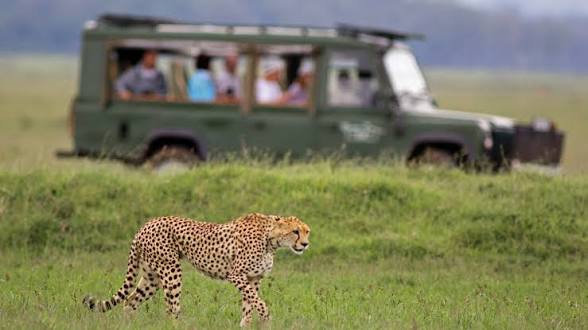
Ladakh has launched India’s first high-altitude Snow Leopard Safari to promote responsible wildlife tourism, protect the fragile mountain ecosystem and generate livelihood opportunities for local communities. Lieutenant Governor Vinai Kumar Saxena inaugurated the initiative during Wildlife Week 2026, marking a new step towards conservation-led tourism in the Union Territory.
The safari is being organised by the Snow Leopard and High-Altitude Nature Conservation (SHAN) Society in collaboration with Ladakh’s Department of Forest, Ecology and Environment. Initially, six specially designed vehicles will operate in snow leopard hotspots, including Rumbak, Shang and Uley, offering visitors guided wildlife experiences.
The initiative will use local drivers and wildlife guides, designated routes and restrictions on visitor activities to minimise disturbance to animals and their habitats. It also aims to discourage unauthorised off-road driving, which can damage fragile high-altitude landscapes and disrupt wildlife. The programme seeks to integrate tourism with conservation while creating economic opportunities for residents.
Ladakh is a critical region for snow leopard conservation in India, with its rocky mountains, steep slopes and high-altitude valleys providing suitable habitat for the elusive species. The region is home to an estimated 477 snow leopards, the highest population among Indian regions, according to the first Snow Leopard Population Assessment in India conducted between 2019 and 2023.
The national assessment estimated India’s snow leopard population at 718. Besides Ladakh, the estimated populations include 124 in Uttarakhand, 51 in Himachal Pradesh, 36 in Arunachal Pradesh, 21 in Sikkim and nine in Jammu and Kashmir. The assessment covered approximately 120,000 square kilometres, representing more than 70% of the species’ potential range in India.
Beyond the initial safari locations, areas such as Hemis National Park, Changthang Wildlife Sanctuary, Karakoram Wildlife Sanctuary, Nubra, Zanskar, Sham, Kargil and Drass have been identified for exploring suitable wildlife tourism routes. Their inclusion in planning does not mean safari operations have begun at every location. The initiative aims to establish a carefully managed tourism model that supports snow leopard conservation, strengthens local livelihoods and raises awareness about Ladakh’s unique biodiversity.