


Marking its centennial year, the Indian Chamber of Commerce (ICC) hosted a day-long Aviation & Tourism Conference (ICC Aviation & Tourism Conference 2025) in New Delhi. Organized under the theme “Viksit Bharat 2047: Transforming Indian Tourism for Global Excellence,” the event convened numerous high-profile speakers from both public and private sectors, including Omar Abdullah, Chief Minister of Jammu & Kashmir; Abhyuday Jindal, President, ICC, and Managing Director, Jindal Stainless Ltd; V Vualnam, Civil Aviation Secretary, Government of India; Suman Billa, Additional Secretary of Tourism, Government of India; Dr Subhash Goyal, Chairperson, CII Expert Committee on Aviation & Tourism; Rajeev Singh, Director General, ICC; and Chander Mansharamani, Co-Chair, ICC Expert Committee on Aviation & Tourism, among others.
Addressing a special session, Chief Minister Omar Abdullah emphasized the significant importance of both aviation and tourism for the Union Territory. “While tourism generates considerable enthusiasm and positivity for us, the other occasionally causes us some hard time,” Abdullah noted, referring to the excessively high airfares for flights connecting Jammu and Srinagar. Acknowledging that Jammu and Kashmir had recently garnered attention for negative reasons, Abdullah stated, “But I can confidently say that we have turned the corner. Jammu and Kashmir is once again a prominent destination for domestic tourists nationwide and is increasingly gaining popularity among international travelers.”
He pointed out that rapid tourism growth also brings challenges such as over-tourism. Consequently, his government plans to develop nine new destinations, expected to be funded through multilateral agencies. “We anticipate that these new destinations will alleviate pressure on popular areas in the valley and also unlock some undiscovered regions of Jammu for tourism,” the Chief Minister stated. He further emphasized that J&K needs to reposition itself as a destination for value tourism rather than volume tourism, focusing on enhancing the quality of tourist experiences. Regarding aviation-related issues, the Chief Minister remarked that this is a matter that “constantly bothers us” in Jammu & Kashmir. “Airfares, even for a half-hour flight between Jammu and Srinagar, are at times ridiculously high,” he said. However, he expressed optimism that the anticipated inauguration of the Vande Bharat train connecting Jammu to Srinagar by the Prime Minister in the coming weeks will improve accessibility to Kashmir and reduce airfares.
Abdullah also advocated for the revival of J&K’s past prominence as a honeymoon and film shooting location, while also highlighting its potential for destination weddings.
Delivering a keynote address during a session titled ‘The Role of Aviation in Developing Tourism to Indian States,’ V Vualnam, Civil Aviation Secretary, Government of India, highlighted the close inter-linkage between tourism and civil aviation. “The growth of air connectivity is progressing in two important directions: the commercial flight segment, which has shown consistent year-on-year growth,” Vualnam said, emphasizing that doubling both air passenger numbers and the number of airports within a decade are significant achievements. Moreover, he noted, “Our airlines are confident in doubling their aircraft fleet in the next 10 years. This confidence underscores the anticipated growth of India’s aviation sector and the increasing number of air passengers.”
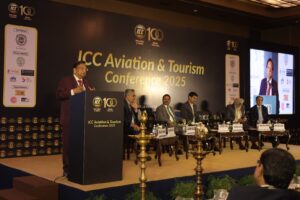 Talking about the Regional Connectivity Scheme (RCS), also known as UDAN, Vualnam said that the scheme is aimed at connecting tier-II and tier-III cities. “This scheme facilitates passenger access to major airports and even enables them to fly to international destinations,” he stated. Vualnam also mentioned the recent budget’s proposal to extend the UDAN scheme for another 10 years and to connect 120 new destinations under it. “The UDAN scheme has facilitated travel for approximately 1.5 crore people so far, and the government has set a target of an additional 4 crore passengers through this scheme,” Vualnam added. In another significant development, the Civil Aviation Secretary announced that the Government has streamlined the guidelines for operating seaplanes in the country. “Successful seaplane demonstration flights were conducted last November, and I am confident that seaplanes will become a reality by the end of 2025,” Vualnam stated. He also informed that MoCA is in discussions with MoT to scale up the Buddhist circuit to attract more tourists by enhancing air connectivity to Buddhist sites and offering comprehensive packages to visitors from countries like Japan, Korea and others.
Speaking at the event, Suman Billa, Additional Tourism Secretary, Government of India, also stressed the need for greater synergy between the aviation and tourism sectors. He asserted that both are dynamic components of the Indian economy with the potential to become twin engines for economic growth if effectively integrated. “Tourism contributes 5.04 per cent to our national GDP, but considering our immense potential, this contribution should ideally be around 10 per cent. Therefore, the government, as stated by Honourable Prime Minister Modi previously, aims to double this contribution to 10 per cent in the next 10 years,” Billa said.
However, he pointed that the challenge lies in how the aviation and tourism sectors can collaborate to realize their combined potential. To address this challenge and foster synergy, Billa stressed the importance of aligning the country’s air connectivity plan with the tourism development plan and advocated for policy collaboration between the two sectors. To this end, Billa stated that the Ministry of Tourism has proposed a joint task force with the Ministry of Civil Aviation to foster closer alignment.
Finally, Billa noted that all projections India’s tourism sector will become a trillion dollar economy by 2047, and by then, it is also anticipated that India will be home to several world-class aviation hubs.
Addressing the conference, Dr Subhash Goyal cautioned that achieving a trillion-dollar tourism economy would be difficult without addressing existing challenges and prioritizing inbound tourism. Expressing concerns about the current state of inbound tourism, he noted, “India received 11.5 million foreign tourists in 2019, but our inbound tourism is still below its pre-pandemic peak. While destinations like Thailand, Malaysia, and many others also suffered due to the pandemic, unlike India, they have fully recovered and are experiencing further growth.”
According to Goyal, India’s struggling inbound tourism is due to extremely high airfares on most overseas routes compared to 2019, a result of demand outpacing the supply of air seats. Goyal attributed this supply-demand imbalance to India’s restrictive civil aviation policy based on principles of reciprocity and bilateral agreements. Discussing India’s stated goal of becoming a trillion-dollar tourism economy, Goyal emphasized the difficulty of achieving this ambitious target if the supply-demand mismatch on international routes persists.
“It is high time that we create more air seats on international routes to meet growing demand,” Goyal urged, adding that the policy of reciprocity in civil aviation is not in the national interest. “The government should introduce an open sky policy allowing interested foreign carriers to fly to India.” Furthermore, Goyal underlined the need to connect more Indian cities with international flights to boost inbound tourism. “While domestic tourism is important, what India needs is thriving inbound tourism to create quality jobs and eradicate poverty,” he concluded.
Earlier, in his welcome address, Abhyuday Jindal underscored India’s vast tourism potential and stressed the necessity of synergy to capitalize on it. “India is not just one country, but many worlds woven together. Coupled with its spirit of Atithi Devo Bhava, India possesses all the necessary ingredients to become a global tourism powerhouse,” Jindal stated, adding that a modern and well-connected aviation and tourism ecosystem is crucial for realizing this. “To fully unlock the country’s tourism potential, ICC has united two interdependent sectors, aviation and tourism, under a single collaborative platform, with the aim of building a future where India’s aviation and tourism industries will grow and lead,” Jindal further explained.
The day–long conference featured several relevant sessions covering topics such as the role of aviation, infrastructure, and connectivity in developing tourism, as well as wedding and MICE tourism.