

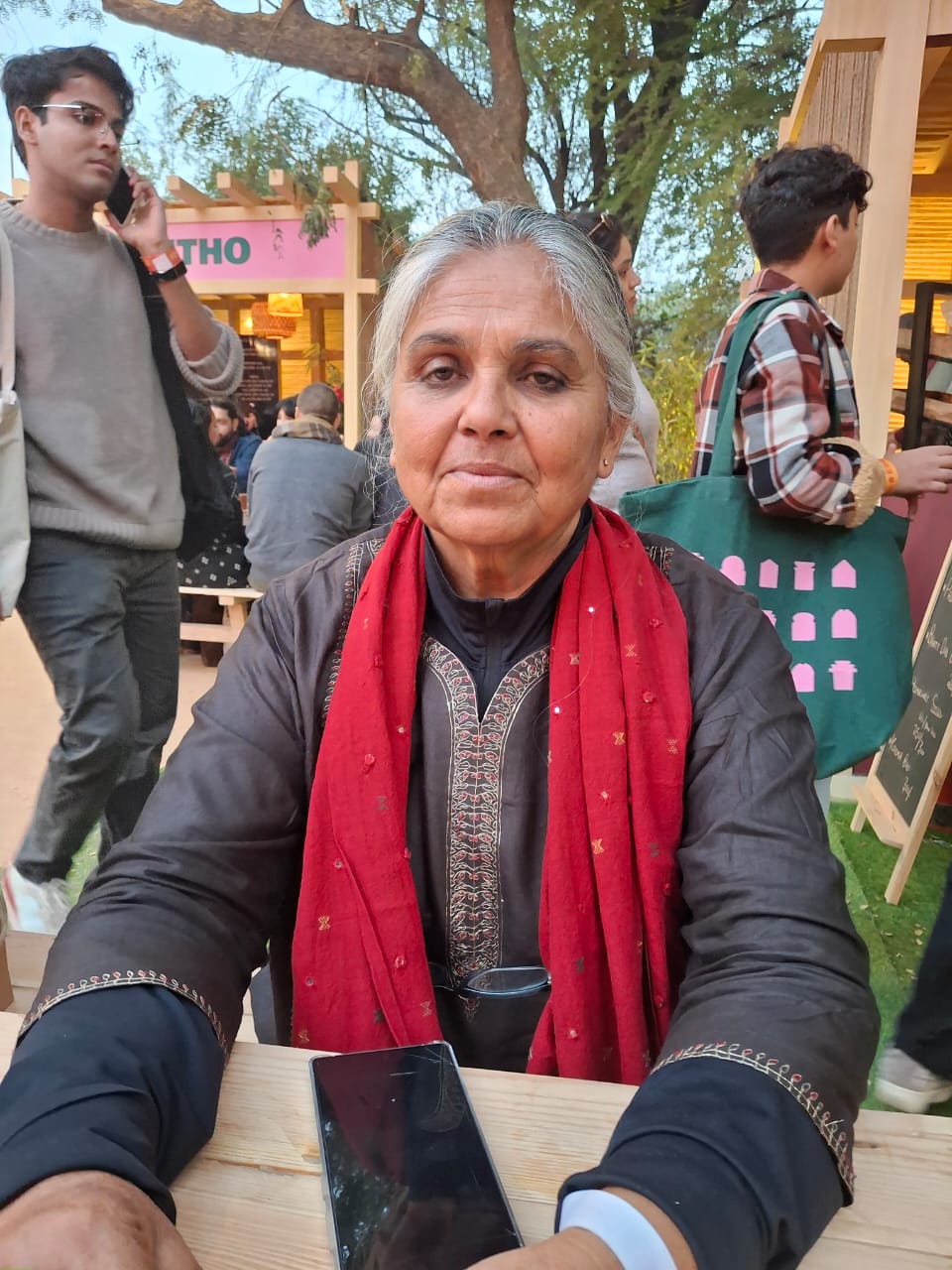
Homestays, when rooted in community ownership and collective control can become powerful tools for livelihood generation, nature conservation and cultural preservation. But once they slip into the realm of individual, market-driven businesses, their very philosophy stands diluted. This is the central argument made by Mallika Virdi, a long-time crusader for community-led conservation and sustainable livelihoods in Uttarakhand, whose pioneering work in Munshiyari helped shape India’s early homestay movement.
Speaking exclusively to TravelBiz Monitor on the sidelines of a week-long showcase of the Himalayan life, nature, art, craft and culture – Journeying Through the Himalayas – by Royal Enfield Social Foundation in Delhi, Virdi said that there are a lot of risk involved when you invite market into your private space, and this risk can only be mitigated when it is operated as a cluster under the guidance and supervision of a community system.
Mallika Virdi first came to prominence in 2003–04 as the first woman sarpanch of the Sarmoli Van Panchayat in Munshiyari, a village where forest commons are owned and managed collectively by the community. It was here, in 2004, that she helped introduce a community-controlled homestay model—long before homestays became a buzzword in Indian tourism. The initiative later took formal shape as The Himalayan Arc, registered as a firm in 2016.
In 2023, Sarmoli was recognised by the Ministry of Tourism as the Best Rural Tourism Destination, an honour that acknowledged nearly two decades of community-driven work. Yet, looking back, Virdi says the recognition has also exposed deep misunderstandings about what homestays are meant to be.
The 2023 award, however, triggered an influx of individually run homestays outside the community framework. According to Virdi, this surge has undermined the very principles that made Sarmoli and Munshiyari a model destination.
“After the award, so many homestays opened without the philosophy that protects rural homestays,” she said. “Rural tourism has to be community-based because the assets you depend on—natural resources, cultural capital—are community-owned.”
Virdi traces the origins of the homestay initiative in her Van Panchayat to a governance challenge rather than a tourism opportunity. As sarpanch of the Van Panchayat—a non-coveted but critical post responsible for managing forest commons—she found community participation weakening as market-based livelihoods reduced people’s dependence on forests.
“To call people for meetings to look after our natural heritage, we had to find a livelihood that went along with conservation,” she recalled. “That was the pivot behind homestay initiative.”
Homestays were introduced as a privilege, not a free-for-all business. Only right holders who actively contributed to forest protection, plantation work and community responsibilities were allowed to run them. Each household was limited to one or two rooms, keeping the model small, non-extractive and far removed from resort-style tourism.
By 2019, the initiative had grown to include 25 families and generated a turnover of nearly Rs 50 lakh annually—without external support. Earnings were shared equitably, and 2% per cent of all income was reinvested into forest upkeep through the Van Panchayat.
“It was environmentally responsible because the forest gave us the income,” Virdi said. “It was socially responsible and equitable because it wasn’t the biggest or fanciest houses that earned the most.”
“Homestays as a concept are very good. But homestays are a misunderstood concept,” she said. “Unfortunately, even our government thinks this is a cheap alternative to hotels. It isn’t. It’s about cultural immersion.”
Virdi believes branding destinations without safeguarding governance structures leads to short-term gains but long-term damage.
“You gave us an award, but you didn’t understand our philosophy,” she said.
In this context, Virdi raised questions on Uttarakhand government’s UttaraStays, a Homestay scheme for registering individual operators rather than recognising community clusters. “By promoting homestays the way they are, the government is exposing communities to a very voracious market,” she warned. “We will end up paying the cost.”
Beyond sustainability, Virdi raised concerns about safety and social risk—often ignored in homestay policies. “When you run a hotel, the manager’s family doesn’t live there. In a homestay, you are opening your private space to the market,” she explained. “That is risky.”
Community control, she argues, provides a critical safety net. Collective decision-making, shared pricing, rotation systems and mutual support ensure that no individual bears the full burden of market exposure.
Under the Himalayan Arc’s roster system, guests are allocated in turns, with priority given to families most dependent on tourism. Those with alternative incomes take fewer turns. “It’s not charity,” Virdi said. “It’s a business model that understands equity.”
“Homestays are not about cheaper beds,” she said. “They are places for cultural immersion. They come with quality, personal investment and risk. That is why they must remain within the confines of community control.”
She believes community-managed homestay clusters can offer scale without sacrificing values. In Munshiyari, aggregated homes can host up to 60 guests on any given night—enough to cater to large groups while retaining intimacy and accountability.
“They are guests of the community,” she said. “That makes all the difference.”
For Virdi, the future of responsible tourism lies not in unchecked growth, but in collective governance.